Before the Printed Score: Keeping Music in Memory
Before the printed score, oral music transmission carried songs through listening, memory and shared performance. See how communities kept music alive.
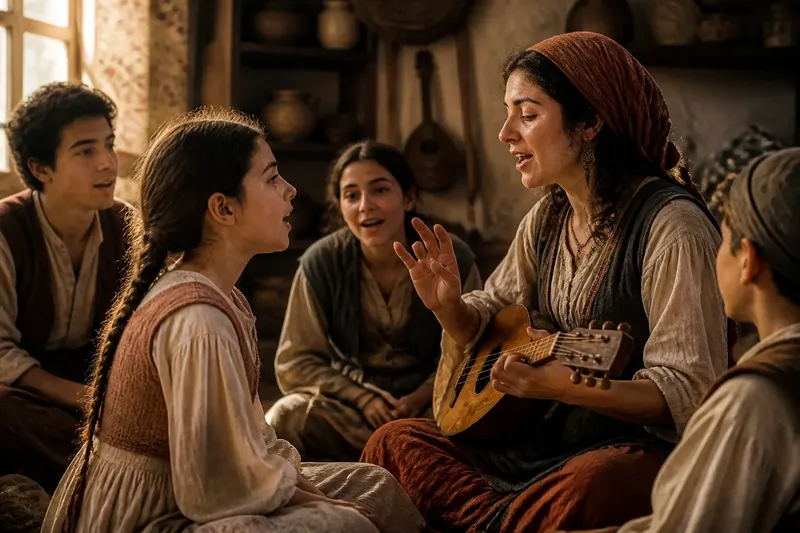
Before the printed score, a melody travelled from one person to another by ear: sung at work, played at a gathering, or learned beside a skilled musician. Oral music transmission was not simply a way to preserve notes; it tied music to the people, occasions and choices that kept it in use.
How did people learn music before notation?
They listened, watched and joined in. A learner might absorb a tune by hearing it repeatedly, then try a phrase while a more experienced singer or player supplied the next cue. Rhythm, gesture, words and the sound of an instrument all helped memory take hold.
Teaching could happen in ordinary settings rather than a formal lesson. A lullaby passed between generations, a work song learned alongside a task, or a dance tune picked up at a communal event each came with practical signals: when to begin, where to breathe, how the beat moved and what the music was for.
Say a young player hears a neighbour perform a short dance melody at a local gathering. The neighbour sings the tune slowly, the learner echoes it phrase by phrase, and the pair then try it at the dance’s usual pace; the learner is expected to remember not only the pitches but the lift that invites dancers to move.
What did oral transmission preserve besides the tune?
It carried a way of performing. A melody’s shape might be recognisable across tellings, while its ornament, tempo, wording or emphasis shifted with the singer and the moment. Those details were not necessarily errors against a fixed original; they could be part of a living practice.
Memory also held social knowledge. A tune could signal a ceremony, mark a season, accompany labour or bring a community together. Learning it meant learning when it belonged, who might lead, and how others were expected to respond.
For that reason, a bare sequence of pitches can tell only part of the story. The same tune performed as a cradle song and as a dance may call for different pacing, vocal colour and expression, even if a written transcription makes their notes look similar.
Why did communities rely on memory?
For much of musical history, written notation was unavailable, unfamiliar, or poorly suited to the music people wanted to share. Reading and copying notation required particular skills and materials; a memorised song could travel wherever people carried it.
Oral learning also fitted music that depended on variation or participation. A leader could lengthen a phrase for a group response, a player could shape a melody around a particular instrument, and dancers could influence the pace. The performance itself became a place where musical knowledge was used and renewed.
Memory was not infallible, and music did change as it passed between people. Yet change need not mean that transmission had failed. A community could recognise a tune through its central contour, rhythm, words or function, even as individual performances differed.
What changed when written and printed scores spread?
Notation made it possible to record musical ideas in a form that readers could consult away from the original performer. Printed scores could circulate beyond the circles where a tune was first learned, supporting shared repertoires and performances by musicians who had never met the composer or teacher.
But notation could not capture every feature equally well. It might indicate pitches and rhythmic relations while leaving room for choices of tone, phrasing, ornament and local style. A score therefore often worked best alongside listening, demonstration and established habits of performance.
Written and oral methods did not simply replace one another. Musicians could read a score, hear a recording, ask a teacher to demonstrate a passage and then rely on memory during performance. The balance varied by tradition, instrument and musical purpose.
How does oral music transmission still work?
It continues wherever people learn by listening and doing: in family singing, community ensembles, dance traditions, informal sessions and teaching studios. Recordings can support the process, but repeated attention to a living performer still reveals timing, breath, articulation and interaction that a notation may leave open.
To learn a tune orally, listen for its phrases rather than trying to hold every sound at once. Hum the outline, notice where the melody repeats or turns, then practise a short section before joining it to the next. If a teacher or recording is available, return to it to check the details your memory has blurred.
When passing music on, demonstrate as well as explain. Sing a phrase, invite an echo, and give the learner room to attempt it; short exchanges make it easier to notice where the rhythm or contour needs another hearing. Ask about the tune’s setting too, so its purpose travels with its sound.
Which questions help explain oral music transmission?
Does oral music stay exactly the same?
Not always. Performers may vary details while keeping features that make the tune recognisable, and those differences can reflect a tradition’s normal way of performing.
Can a song be learned without reading music?
Yes. Listening, imitation, repetition and guidance from other musicians can teach a melody and its performance without requiring notation.
Did printed scores end learning by ear?
No. Scores offered another way to record and share music, while oral teaching remained useful for sound, style, memory and collaboration.
What can a score leave out?
It may not fully describe the tone, phrasing, ornament, context or interaction that shape a particular performance. Listening to musicians can supply those details.
What can a listener notice in an oral tradition?
Listen for the points that make a tune easy to carry: a recurring phrase, a strong rhythmic pattern, a call answered by a group, or words that cue the next musical turn. Then notice what changes between performers. A shift in ornament or pace can reveal how individuals make the music their own without losing its shared identity.
That is the enduring lesson of music kept in memory: preservation can be an active exchange, not a frozen copy. Before the printed score, oral music transmission joined sound to human attention; listening closely now offers a way to hear both the tune and the community that carries it.